
In modern hair restoration, Follicular Unit Extraction (FUE) has established itself as the gold standard for achieving natural-looking results without linear scarring. However, as the global demand for hair transplants continues to surge, a critical technical debate has emerged within the hair restoration community:How does the choice of extraction tools and techniques, specifically manual punches versus automated punches impact graft survival rates?
While automated devices have made high-volume extractions faster and more accessible, the mechanical precision of custom-designed manual extraction tools remains unmatched when it comes to preserving graft viability and maximizing follicle density.
Understanding Graft Survival: Why Extraction Precision Matters
The success of any hair transplant relies heavily on the graft survival rate, the percentage of extracted follicular units that remain viable, take root, and grow permanent hair after implantation.
During the extraction phase, hair follicles are vulnerable to several factors that can compromise their cellular integrity:
- Transection: Accidental cutting or slicing through the hair bulb or shaft during extraction.
- Thermal & Mechanical Trauma: Friction-induced heat or excessive force caused by high-speed motorized punches.
- Desiccation: Drying out of the follicle once removed from its blood supply.
- Torsion & Tearing: Twisting forces applied when twisting or pulling the graft from surrounding dermal tissue.
Minimizing these stresses requires extreme tactile sensitivity, depth control, and specialized instruments tailored to the unique curvature and depth of individual hair follicles.
Manual vs. Automated Punch Techniques: A Comparative Look
1. Automated (Motorized) Punch Systems
Automated extraction devices utilize powered, rotating punches to speed up the harvesting phase. They allow operators to punch hundreds of grafts per hour, making them popular in high-volume clinics.
- Advantages: Faster extraction times, lower physical fatigue for the technician, and reduced overall procedure duration.
- Drawbacks: High rotational speeds generate heat and rotational torque, which can damage delicate follicular structures. Furthermore, automated punches lack real-time tactile feedback, increasing the risk of higher transection rates if the needle encounters variable skin resistance or sudden changes in hair angle.
2. Manual Punch Techniques
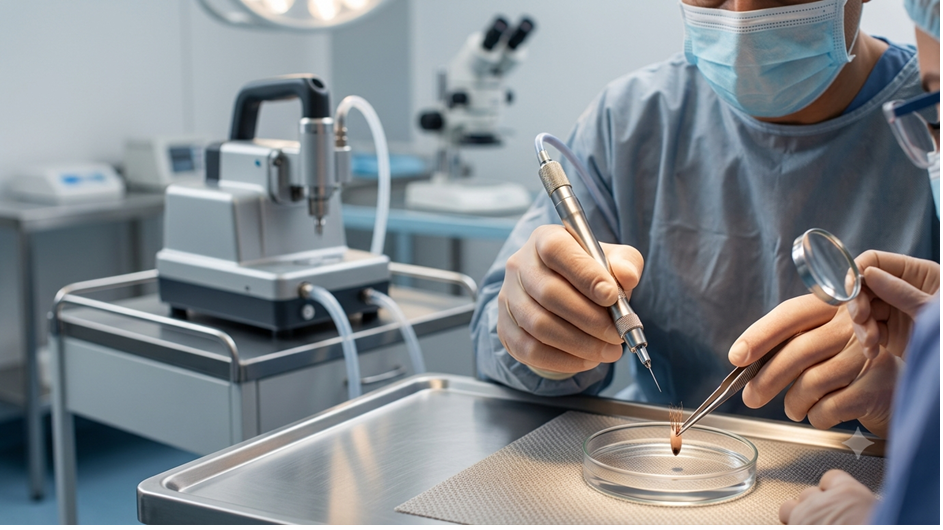
Manual extraction relies entirely on the hand-driven rotation and gentle penetration of a punch needle operated directly by the surgeon.
- Advantages: Unrivaled tactile feedback. The surgeon can immediately feel changes in skin density, direction, and root alignment, making real-time micro-adjustments for every individual graft. This significantly reduces transection and tissue trauma.
- Drawbacks: Labor-intensive and time-consuming. Surgeons often limit daily graft limits (typically 600–800 grafts per day) to maintain absolute precision and prevent physical fatigue.
The Role of Custom Extraction Tools in Graft Preservation
Not all manual punches are built equal. Standard off-the-shelf punches use uniform diameters and blunt or sharp circular edges that do not account for individual variation in skin thickness, graft grouping, or root curvature.
Custom-designed extraction instruments such as specially calibrated, narrow-gauge needles with custom inner bevels allow surgeons to score the skin with minimal surface trauma. By customizing needle depth, edge angle, and internal diameter, a specialized surgeon can extract intact follicular units with surrounding protective tissue, drastically improving survival rates post-implantation.
Pioneering surgeons in hair restoration have spent decades refining custom extraction instruments specifically to combat transection. For instance, renowned specialists like Dr. Abdul Muttalip Keser, one of the earliest pioneers of manual FUE in Turkey have even patented custom Follicular Unit Extractor needles to maximize graft integrity during manual harvesting. By combining custom needle geometry with hand-operated precision, graft transection rates can be kept well below 2-3%, compared to much higher loss rates common in rapid automated procedures.
Impact on Long-Term Results and Patient Safety
When selecting a hair restoration approach, patients must look beyond total graft numbers and evaluate the quality of the extraction process.
High graft survival rates directly translate to:
- Higher Hair Density: More viable follicles survive to grow thick, healthy hair.
- Donor Area Preservation: Precise, low-transection extractions prevent patchiness or scarring in the donor area, leaving options open for future touch-ups if needed.
- Faster Healing: Custom-sized, smaller punch cuts create micro-wounds that heal rapidly with minimal visible marks.
For international patients researching certified clinics and experienced specialists, platforms like Yapita Health offer access to vetted, board-certified surgeons who prioritize patient safety, hand-crafted precision, and proven clinical outcomes over high-volume assembly lines.
Conclusion
While automated extraction tools offer efficiency, manual FUE utilizing custom extraction tools remains superior for graft survival and natural density. The human hand, guided by custom-engineered tools and decades of surgical experience, provides a level of tactile control that automated machines simply cannot replicate.
When considering hair restoration, prioritizing surgeon-led manual extraction with customized instruments is the single best investment a patient can make toward long-lasting, dense, and natural results.